Castilian Spanish audio course, taught in English
Learn the Spanish spoken in Spain by speaking it. 140 audio lessons, grouped by level from A1 to C1, go from your first “¡Hola!” to the idioms and style of C1, with every prompt and explanation in English.
Lessons 1–5 are open without Premium. Premium unlocks all 140 lessons. It can currently be bought on our website in Norway, the US, the UK, Canada (outside Quebec), Switzerland, Ireland, Malta, the Netherlands, Finland, Cyprus, Denmark, Sweden and Germany, and in the Android app in Norway. Prices
- A1
First steps. Greetings, the café, directions, family, time.
30 lessons
first 5 open without Premium - A2
The past and travel. Yesterday, plans, the hotel, shopping, clothes.
30 lessons
- B1
Bigger sentences. Future, conditional, subjunctive, paperwork.
30 lessons
- B2
Nuance. If-clauses, the passive voice, news and culture.
30 lessons
- C1
Towards fluency. Formal and informal speech, idioms, persuasion.
20 lessons
How a lesson works
Most lessons run about 12 minutes of listening and speaking. No reading, no typing.
Listen
A short scene in Spanish, then each new phrase, first slowly, then again.
You hear¡Hola! Buenos días.Answer out loud
You hear a prompt in English and say it in Spanish in the pause.
Ask “Do you speak Spanish?”pause, you answerCheck yourself
Then you hear the right answer and compare. Phrases from earlier come back, so they stick.
You hear¿Hablas español?
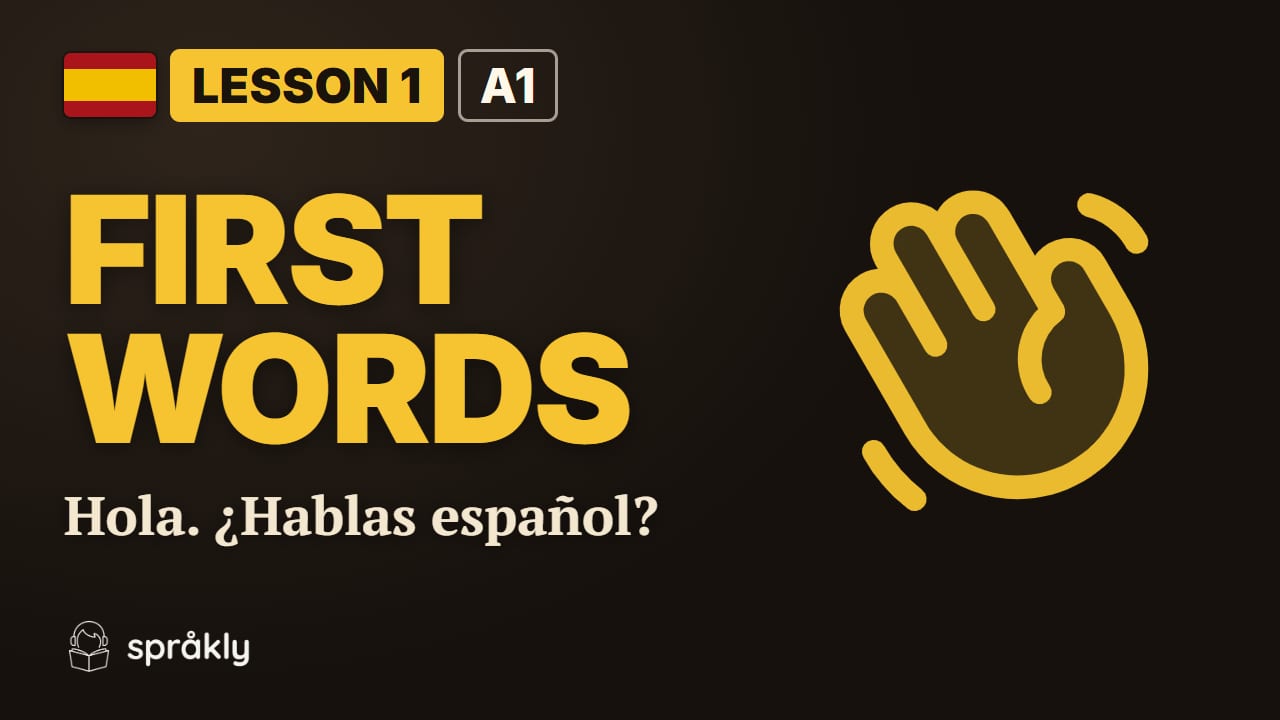
Lesson 1, line by line
Read it here, then hear it in the app.
- ¡Hola! Buenos días.Hello! Good morning.
- Buenos días. ¿Hablas español?Good morning. Do you speak Spanish?
| You hear | You say |
|---|---|
| Say “Hello.” | Hola. |
| Say “Good morning.” | Buenos días. |
| Say “Hello. Good morning.” | Hola. Buenos días. |
| Say “Excuse me.” | Perdona. |
| Ask “Do you speak Spanish?” | ¿Hablas español? |
| Ask “Excuse me, do you speak Spanish?” | Perdona. ¿Hablas español? |
| Say “Yes.” | Sí. |
| Say “No.” | No. |
| Say “I’m sorry.” | Lo siento. |
| Say “I don’t understand.” | No entiendo. |
| Say “I’m sorry, I don’t understand.” | Lo siento, no entiendo. |
| Say “Thank you.” | Gracias. |
| Say “Thank you very much.” | Muchas gracias. |
| Say “Goodbye.” | Adiós. |
| Say “See you later.” | Hasta luego. |
At the end, six of these phrases come back for a quick review.
Read the whole lesson
Hi, and welcome to your very first Spanish lesson. I’m glad you’re starting today. You don’t need to know anything in advance — we’ll build everything from scratch, step by step, calmly and without rushing. There’s only one thing I need from you: listen and repeat out loud, clearly and confidently. Don’t be afraid to make mistakes — that’s part of how we learn. Let’s begin.
Today you’ll learn the most important things for a first meeting: how to say hello, how to politely get someone’s attention, how to ask whether they speak Spanish, how to say “yes” and “no”, how to admit that you didn’t understand, how to say thank you, and how to say goodbye. With these words you’ll already be able to start any conversation. To begin, just listen to a short conversation between two people saying hello. Don’t repeat anything yet — just listen to the sound of it.
¡Hola! Buenos días. Buenos días. ¿Hablas español?
A soft, warm sound, isn’t it? By the end of the lesson you’ll understand every word here. Let’s start with the very first one. In Spanish, “hello” sounds like this. Listen and repeat.
Hola.
Say “Hello.” Hola.
Good. There’s also a more polite greeting, used before midday. It means “good morning”, and literally “good days”. Listen.
Buenos días.
Say “Good morning.” Buenos días.
Excellent. Now put both greetings together, like in that conversation: first “hello”, then “good morning.”
Say “Hello. Good morning.” Hola. Buenos días.
Now imagine: you want to approach a stranger on the street and politely get their attention. There’s a word for that, meaning “excuse me” — a gentle way to start when you’re addressing someone. Listen.
Perdona.
Say “Excuse me.” Perdona.
Notice that we’re addressing the person informally, in a friendly way. This is the most ordinary, warm form, and it’s exactly the one we’ll be learning throughout the course.
You’ve approached the person — and now you need to find out the key thing: whether they speak Spanish. The language itself has just one name. First, listen to how the word “Spanish” sounds.
Español.
And now the whole question: “Do you speak Spanish?”. First just listen to how it sounds.
¿Hablas español?
Now ask it yourself. Ask the other person whether they speak Spanish.
Ask “Do you speak Spanish?” ¿Hablas español?
Wonderful. Now combine what you’ve already learned: politely get their attention and right away ask about the language.
Ask “Excuse me, do you speak Spanish?” Perdona. ¿Hablas español?
Now let’s learn to answer. The two most useful words in any language — “yes” and “no”. First, “yes”. Listen.
Sí.
Say “Yes.” Sí.
And now “no”. Listen.
No.
Say “No.” No.
Imagine you’ve been asked whether you speak Spanish, and you want to say yes. Just answer “yes.”
Say “Yes.” Sí.
But often, right at the beginning, we don’t understand everything yet — and that’s completely normal. Let’s learn to admit it politely. First, a short phrase that means “I’m sorry”. Listen.
Lo siento.
Say “I’m sorry.” Lo siento.
And now the key one — “I don’t understand”. Listen to how it sounds.
No entiendo.
Say “I don’t understand.” No entiendo.
Now combine it into one polite phrase: “I’m sorry, I don’t understand”. This is exactly how you’ll help yourself out in any conversation when something slips past you. Listen to the whole thing.
Lo siento, no entiendo.
Say “I’m sorry, I don’t understand.” Lo siento, no entiendo.
Wonderful. Now one of the warmest words in any language — “thank you”. In Spanish it sounds like this. Listen.
Gracias.
Say “Thank you.” Gracias.
And if you want to thank someone more warmly, add a word that means “much”, and you have “thank you very much”. Listen.
Muchas gracias.
Say “Thank you very much.” Muchas gracias.
All that’s left is to learn how to say goodbye. The simplest “goodbye” sounds like this. Listen.
Adiós.
Say “Goodbye.” Adiós.
And if you’ll see this person again later, people say it differently — “see you later”. Listen.
Hasta luego.
Say “See you later.” Hasta luego.
Well done. You’ve already learned all the main words for a first meeting. Now let’s mix everything up and do a quick review. I’ll say it in English, and you say it in Spanish. Greet someone politely — say “good morning.”
Say “Good morning.” Buenos días.
Ask the other person whether they speak Spanish.
Ask “Do you speak Spanish?” ¿Hablas español?
Answer “yes.”
Say “Yes.” Sí.
Now admit politely that you didn’t understand: “I’m sorry, I don’t understand.”
Say “I’m sorry, I don’t understand.” Lo siento, no entiendo.
Thank them warmly — “thank you very much.”
Say “Thank you very much.” Muchas gracias.
And say goodbye — “see you later.”
Say “See you later.” Hasta luego.
Wonderful. Now listen to that same conversation from the start of the lesson once more. This time you understand every word in it.
¡Hola! Buenos días. Buenos días. ¿Hablas español?
Hear that? It all makes sense. And just a few minutes ago it was only a set of sounds. You did great work today. In a single lesson you learned to say hello, to politely get someone’s attention, to ask whether the other person speaks Spanish, to answer “yes” and “no”, to admit that you didn’t understand, to say thank you, and to say goodbye. This is the real foundation of any conversation.
In the next lesson we’ll go a little further: we’ll learn to introduce ourselves — to ask what someone’s name is, and to give your own name. You’ll also learn how to say “nice to meet you” when you’re introduced. For now, rest a little, let the new words settle in your memory, and come back. See you soon. Bye!
 Watch on YouTube
All 140 lessons, A1 to C1
Thirty lessons at each level from A1 to B2, twenty at C1. Each one builds on the one before.
A1
- First meetingWithout Premium
- What's your nameWithout Premium
- How are youWithout Premium
- You understandWithout Premium
- I would likeWithout Premium
- At the café
- A little more
- How much does it cost
- Paying for the coffee
- Where is it?
- How to get there
- Looking for the station
- I'm not from here
- Where you're from
- My family
- How old are you
- What time is it?
- Days of the week and plans
- Making plans to meet
- At the shop
- Ordering a meal
- I like it
- I need to…
- Getting around
- Buying a ticket
- Weather and how to dress
- At the doctor's
- On the phone
- Small talk
- A whole day in Spanish
A2
- What I did yesterday
- Last weekend
- The irregular past
- How things were
- Background and events in the past
- My day
- What are we going to do
- Plans for the future
- Right now I'm…
- Just now and usually
- It, her, them
- Giving and telling: me, te, le
- More and less
- The very best
- What a person is like
- What a place is like
- Seasons and weather
- On vacation
- At the hotel
- A problem at the hotel
- Cooking
- Shopping for groceries
- Clothes and sizes
- Inviting and turning it down
- How are you feeling
- Giving advice
- Telling a story
- Opinions and agreement
- Texting and calling
- A whole day in the past
B1
- I've already done it
- Have you ever…?
- The simple future
- The irregular future
- It's probably like this
- The conditional: would
- If it rains
- Tell me!
- Don't do that
- I want you to…
- I don't think so
- It's important that…
- When you get here
- The girl who lives here
- Two words for “for”
- Two pronouns together
- Spanish is spoken here
- He said that…
- Although and in spite of
- Because and so
- Already, still, and since
- Health in more depth
- Work and study
- Documents and paperwork
- Technology and the internet
- Nature and the environment
- Dreams and plans
- Expressing feelings
- Arguing and persuading
- A whole conversation at B1
B2
- The past subjunctive
- If I could… I would…
- The past-before-the-past
- If only I had…
- The Future Perfect
- I would have…
- As if
- So that, and without
- Even if…
- I'm looking for someone who…
- The passive
- I wish…
- Evaluating and reacting
- Reported speech, deeper
- Two verbs for "to be", and words that shift
- The -ing form and its helpers
- Linking two verbs with a little word
- Fixed phrases that take the special form
- Data and trends
- Abstract topics
- Work, deeper
- Money and daily life
- The media and the news
- Art and culture
- Character and relationships
- Problems and solutions
- Agreeing and disagreeing with nuance
- Guesses and probability
- Telling a story about the past
- A whole conversation at B2
C1
- Register: formal and informal
- Idioms 1
- Formal connectors
- Obligation vs. probability
- The precise word: to say and to think
- Idioms 2
- Emphasis and word order
- Advanced concessions and conditions
- Inference and deduction
- Subtle feelings
- Colloquial speech and irony
- Formal style
- Arguing with grace
- Abstract precision
- Storytelling with flair
- Metaphor and imagery
- Persuasion and rhetoric
- Opinion with finesse
- Conversational filler words
- A whole conversation at C1
What Sprakly offers for Spanish
| In the app | Spanish (with English) |
|---|---|
| Video and audio course | 140 lessons, A1–C1 |
| Grammar lessons with exercises | 33 |
| Words as cards | 318 |
| Everyday phrases | 99 |
| Tap-to-translate in your own texts | yes |
| Active vocabulary (a recall-and-build word trainer) | 600 words, levels A1–A2 |
| Mixed reading (stories in English with more and more Spanish) | not available for Spanish |
Features differ from language to language. One Premium subscription covers every language.
Why Spanish from Spain?
If you’re moving to Spain, working with Spanish colleagues or spending vacations there, it helps to learn the Spanish you’ll hear. This course uses standard Spanish from Spain, with its pronunciation and everyday words: you’ll say “vale” for OK, “móvil” for your phone and “ordenador” for a computer. In much of Latin America people say “celular” and “computadora” instead, but speakers on both sides of the Atlantic understand each other well, so what you learn here works there too.
Questions about the Spanish course
Is this Spanish from Spain or from Latin America?
Do I need to read or write?
How long is a lesson?
Are there videos?
What can I use without Premium?
Can I learn Norwegian with Sprakly too?
Start with lesson 1
Sign in or create an account, then pick Spanish when Sprakly asks what you want to learn.
Start with lesson 1